Case study · Personal · Independent
This portfolio
Ownership: Solo · AI-native
My role: Sole engineer, AI-native, using my six-agent pipeline.
- Sector
- Careers & personal
- Context
- Independent
- Ownership
- Solo · AI-native
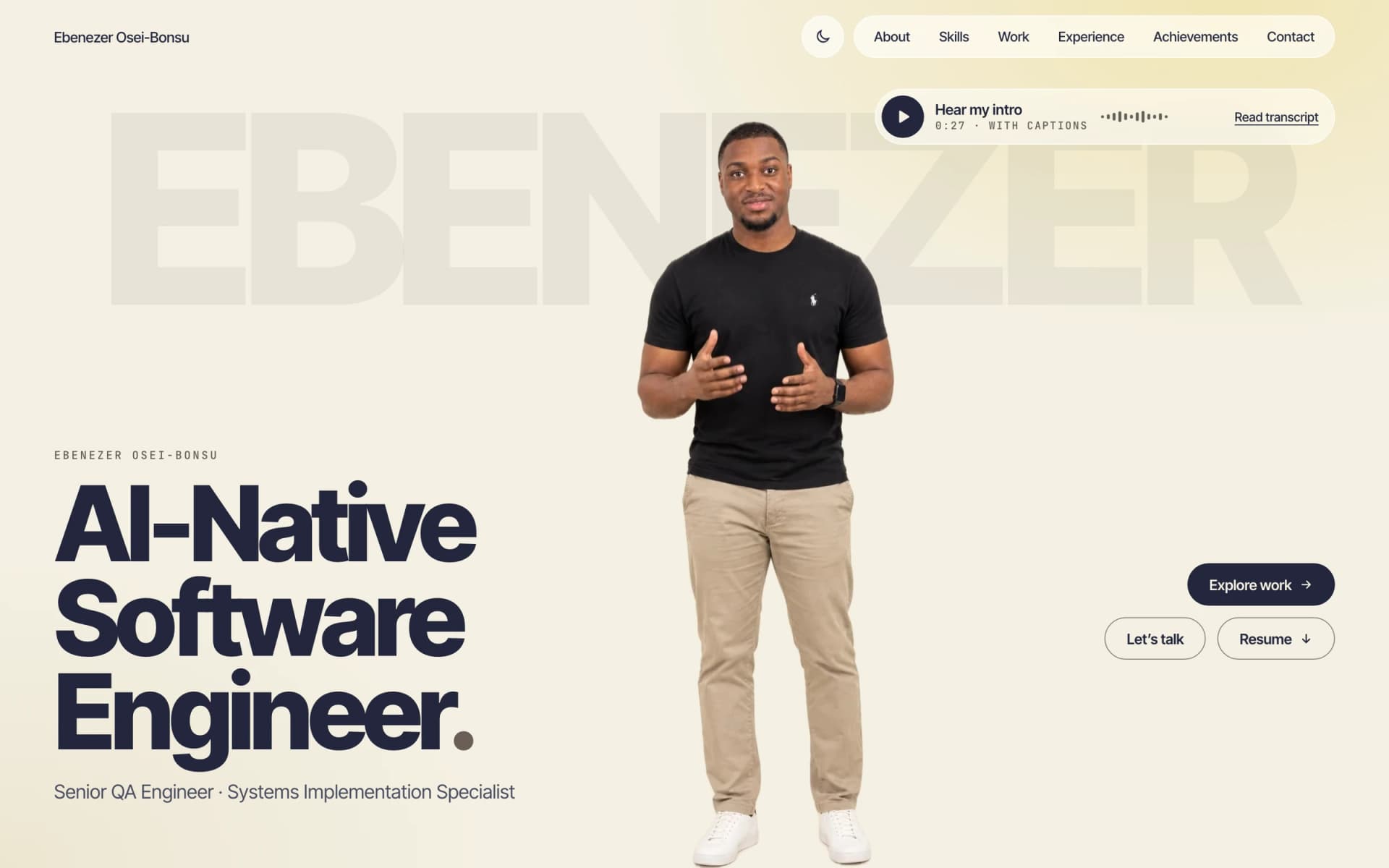
Real screenshot
01 — What it was
This site: my portfolio, presenting the systems I’ve worked on and who did what on each.
02 — Why it mattered
It’s also a working example of how I build: planned, designed, built, reviewed and tested by my six-agent AI pipeline.
03 — My role
Sole engineer, AI-native. I ran six agents in sequence with Claude Code: PM, UI/UX, Dev, Reviewer, QA and Code Improvement.
04 — Technical problems
Rich motion and a 3D lanyard badge had to sit on a site that still works without JavaScript and respects reduced motion. Next.js keeps visited routes mounted, so each interactive part has to set itself up again on every visit without duplicating listeners or replaying animations. And every claim about my work had to trace back to a source.
05 — What I did
Ran each feature through the pipeline: scope and acceptance criteria, a design spec and mockup I signed off, implementation, a security and accessibility review, QA, then code improvement. Kept the pages static and server-rendered, with interactive parts as small client islands. Gated every change on formatting, linting, type checks, unit tests, a production build, Playwright end-to-end and accessibility tests, and Lighthouse CI.
06 — Tools
Next.js (App Router), React, TypeScript, Tailwind CSS, GSAP, Lenis, Three.js, Claude Code, Playwright, Vitest, React Testing Library, axe-core, Lighthouse CI; hosted on Vercel
07 — Result
A fully static site that works without JavaScript, with automated accessibility and no-JavaScript checks in its test suite.
08 — What I learned
Running a pipeline on my own site showed me that what the agents read, the rules, memory and lessons, matters as much as the prompts. The pipeline got better each time I wrote a mistake down.